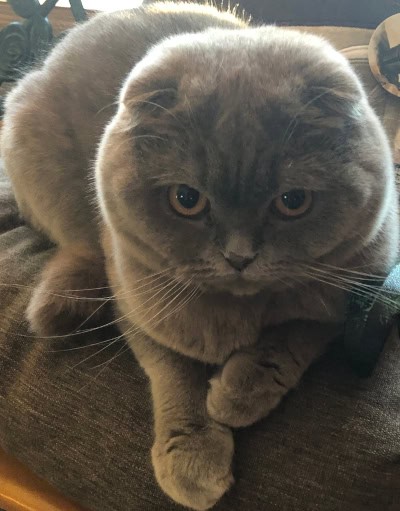
When Luke and Leaya first arrived home at eleven weeks old, they were each roughly the size of a microwave burrito. They were purebred Scottish Folds and they were inseparable. The new environment was frightening enough that they even navigated the litter box as a team. One would stand guard outside while the other went inside, and then they would switch places.
They have lived together their entire lives, developing distinct but complementary personalities. Luke is the “Cuddler” who demands lap time and is the only one who enjoys being picked up. Leaya is the “Athlete.” She is the smarter of the two, constantly inventing new games. She even taught herself a version of football. She lines up next to me, waits for the command to “go long,” and chases a ball down the hall to see how many times she can tap it before it hits the wall. Luke eventually learns these games, but he is usually about two weeks behind his sister.
They were once hunters, or at least they tried to be. When they were five months old, a bat flew into the living room. While I tried to herd the cats away with a cardboard shield, Luke and Leaya had a different plan. They calculated the flight path from under the dining table and pounced. The bat survived and was relocated to a tree outside, but the incident deeply upset the kittens. They have not attacked a living thing since. They do not chase bugs, and they even cuddle with their mouse and bird toys rather than biting them.
That gentle nature made the discovery of a growth on Leaya’s right hind leg all the more devastating.
What we hoped was a minor injury turned out to be a bone growth caused by a genetic disorder called osteochondrodysplasia. It is a nightmare condition common in the breed that causes bones to grow out of control. Eventually, the joints cease to function. Without intervention, the bone growth in the rib cage can constrict the lungs or cut off blood flow from the heart.

This diagnosis brought about a baffling medical mystery. Luke and Leaya are twins. They share a genetic history and an environment, yet Luke has exhibited zero symptoms of the disorder.
In the world of medical research, finding twins where one suffers from a genetic disorder and the other does not is a data goldmine. Because of this unique situation, we began working with three local veterinary hospitals and a team at the James L. Voss Veterinary Teaching Hospital at Colorado State University, one of the top research facilities in the world.
However, the landscape of medical research has changed. Federal research funding for this type of work has been pulled, meaning scientific advancement now relies entirely on private sources. At the same time, the cost of keeping Leaya comfortable and monitoring Luke has risen to more than $500 a month for medications, prescription food, and veterinary visits.
This financial burden has arrived at a difficult time. The computer and web services industry is undergoing a massive overhaul due to artificial intelligence. Job security in my field has vanished, making it impossible to guarantee a steady paycheck to cover these mounting medical costs.
We are fighting to keep Leaya comfortable and to help the researchers at CSU understand why Luke remains healthy. Unlocking that secret could help countless other cats with this condition.
We have set up a GoFundMe to help cover the costs of their ongoing care and research participation. If you cannot donate, simply sharing this story with friends, family, or other Scottish Fold owners is a massive help.
